 |
Saturday, February 26, 2011
Inspired Artivizm on Seattle Streets


Thursday, February 17, 2011
The Design of Dissent
 |
| Egypt April 6 graphic |
 |
| Serbian Otpor logo |
The US press has given a lot of play to a previously obscure American academic, Gene Sharp, who seems to have helped inspire to these brave dissidents and a host of others across Eastern Europe and Asia. I tend to agree with Stephan Gowans' analysis here, Sharp's ideas are the culmination of a long history of non-violent resistence including Gandhi, Martin Luther King and others. Some of his organizing advice is even reminiscent of Rules for Radicals. The idea that one 82 year old American white guy is the major mobilizing impetus for millions of Egyptians is just another form of colonialist thinking (one that Sharp himself rejects, to his credit.)
Sharp, unlike Gandhi and King, is not driven by passion for a political cause. In recent interviews, he has been careful to eschew his "lefty, pacifist" past which included a jail stint for refusing conscription during the Korean War. He is more of a pragmatist these days, promoting non-violence simply because it is the most efficient way to bring about regime change. This focus on the means to the end, along with the fact that he seems to be quite cozy with the US Military (evidently DARPA funded his first book) and the consistency of the fist logo across the many movements he's inspired has led some to conclude that there's a CIA common thread. I guess I wouldn't be too upset to find that some of my tax dollars were helping to train the masses in non-violent organizing techniques designed to topple oppressive dictators--compared to, say, Star Wars missile defense, assassination attempts on Castro, and abstinence-only education. I do wish I knew who was behind the fist design though.

 |
| back to Egypt |
And some more good raised fists (I don't think the CIA had anything to do with these):
 |
| from Cuba |

 |
| IWW Poster, 1917 |
 |
| Tommie Smith and John Carlos' black power protest salute at the 1968 Olympics |
Saturday, January 29, 2011


Wednesday, December 15, 2010
A Street Art Exhibit That Didn't Censor (or why I love New Mexico)
Hip Hop poet/playwright Idris Goodwin teamed up with renowned graffiti artist Chaz Bojórquez in October 2010 to create New Mexico Remix, an interdisciplinary project which incorporates oral history, performance and painting into an exhibition at 516 arts. Goodwin's performance, presented with a projection of Bojórquez's mural, weaves together local sights, sounds and stories to create a multimedia experience.
Despite taking on some difficult themes, the recent street art exhibit at 516 Arts in Albuquerque didn't have to resort to censorship. The 2-month-long celebration of freedom of expression spilled over to spoken word, music and film as well as visual arts. The gallery walls were too small to contain all the art, so the whole town collaborated. Albuquerqueans will enjoy the many new murals scattered over downtown for years to come, none of them buffed after a few hours.
Meanwhile, the controversy over Blu's removal from MOCA LA's street art exhibit continues.
My first foray
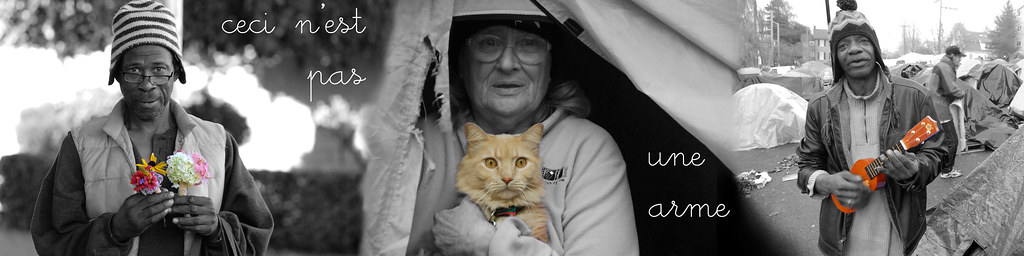
In honor of John T. Williams, I tried my hand at a little street art photo-graffeur-ism tonight


 |
| the original photo |
Friday, December 10, 2010
Blu Buffed!
Looking at street art in a museum, or in this case on a museum’s wall, is sort of like “looking at wild animals in the zoo.” (Daniel Lahoda)If you know anything about Blu, it's probably as incomprehensible to you as it was to me how any self-respecting curator of a "street art" exhibit could invite him to create a mural and then be shocked (shocked!) about its political message. But that's apparently what happened the other day at MOCA in LA just one day after the mural was completed, and one day before a media preview at the museum for another exhibit.
 |
| photo from unurth |
If you don't know anything about Blu, his specialty is beautiful large-scale murals that often reflect local or global political themes. Here are some favorites:
 | |||||
| from Nicaragua, "Hombre Banano" |
 | ||
| Sao Paulo, Brazil |
 |
| And my favorite, from Lisbon, a collaboration with Os Gemeos |
Wednesday, November 17, 2010
Song of John T. Williams
Maybe only poets can cut through the surrealistic double-speak and crazy bureaucratic excuses that pass for justice to make sense of recent events following the cold-blooded murder on August 30th. The victim was shot in the side while innocently crossing the street in broad daylight. He carried a closed pocket knife and a small plank of wood. The event was videotaped and witnessed by several bystanders. The murderer is on a long paid vacation. The victim's family is nearly destitute, living hand-to-mouth in cheap motels, being harassed by the killer's colleagues, men with guns, at every turn.
 Storme Webber's poetic justice doesn't right this wrong. Clearly, the story would be different if we weren't talking about a cop shrouded in impunity and a non-threatening Native American carver, now dead. It's coming on winter, and the combination of the cold wet weather and the cops' harsh treatment has people spooked and uneasy. Rick Williams, John's brother, sells his carved totem poles and masks near Pike Market or at the Seattle Center, now he's wary as the police try to intimidate him. He's asking for support and needs accompaniment. Maybe something like Peace Brigades is called for, someone to serve as a witness and non-violently defend the human rights of those living on the street.
Poet A K Mimi Allin is embarking on another kind of witness, her own self-imposed residency at Seattle's Tent City 3 beginning in December. From her blog, Song of Tent City: "while living in a tent, she'll work full-time at Seattle's migrating, outdoor, homeless encampment. Like Whitman, she believes in the democracy of poetry. 'This is the meal equally set, this the meat for natural hunger, It is for the wicked just same as the righteous, I make appointments with all, I will not have a single person slighted or left away…' From Song of Myself by Walt Whitman."

 Storme Webber's poetic justice doesn't right this wrong. Clearly, the story would be different if we weren't talking about a cop shrouded in impunity and a non-threatening Native American carver, now dead. It's coming on winter, and the combination of the cold wet weather and the cops' harsh treatment has people spooked and uneasy. Rick Williams, John's brother, sells his carved totem poles and masks near Pike Market or at the Seattle Center, now he's wary as the police try to intimidate him. He's asking for support and needs accompaniment. Maybe something like Peace Brigades is called for, someone to serve as a witness and non-violently defend the human rights of those living on the street.
 Poet A K Mimi Allin is embarking on another kind of witness, her own self-imposed residency at Seattle's Tent City 3 beginning in December. From her blog, Song of Tent City: "while living in a tent, she'll work full-time at Seattle's migrating, outdoor, homeless encampment. Like Whitman, she believes in the democracy of poetry. 'This is the meal equally set, this the meat for natural hunger, It is for the wicked just same as the righteous, I make appointments with all, I will not have a single person slighted or left away…' From Song of Myself by Walt Whitman."
Subscribe to:
Posts (Atom)